What Main Avenue Kept Because Nobody Could Afford to Pull It Down
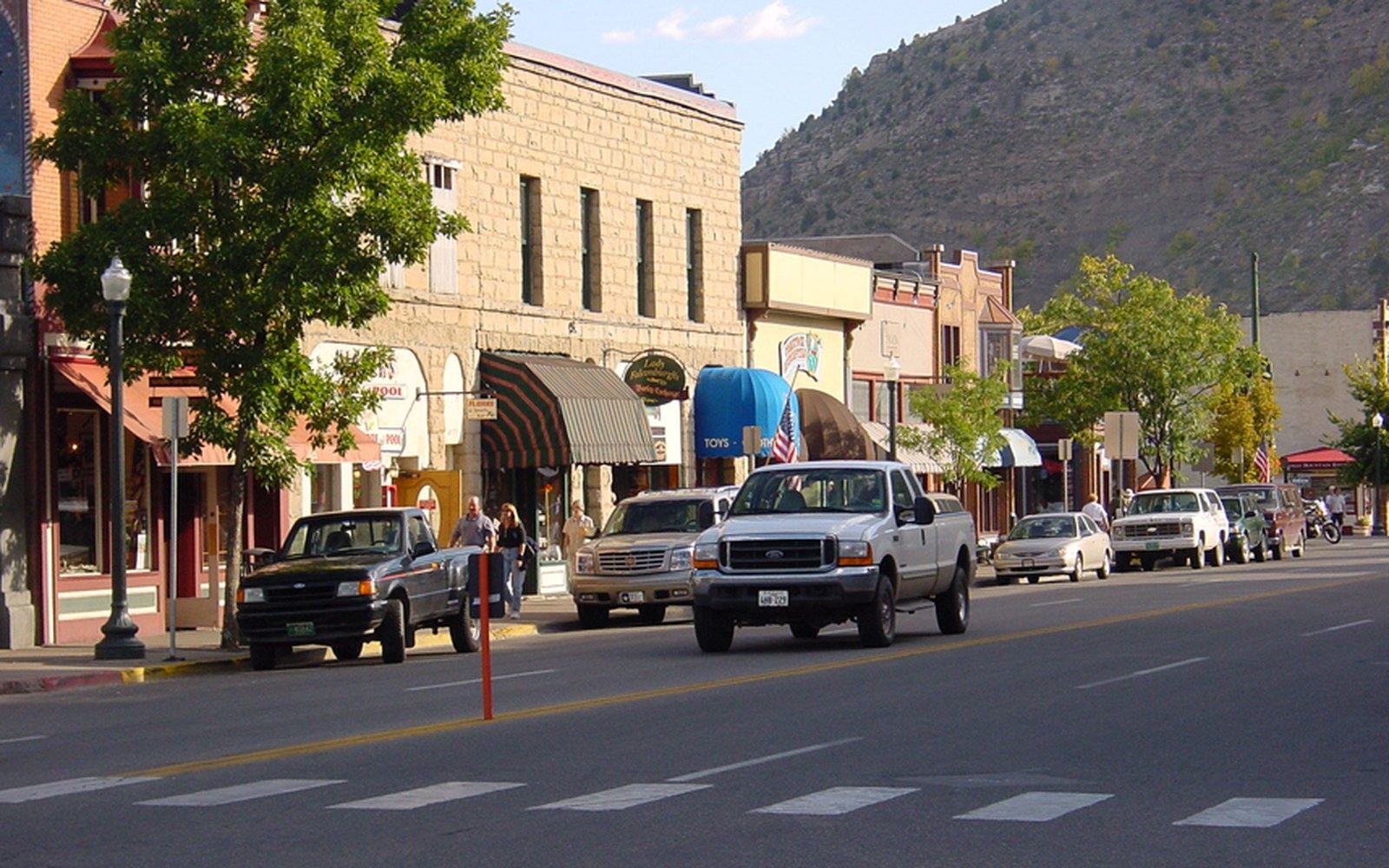
Durango's commercial streetscape survived intact not by civic foresight but by economic stagnation — the buildings are still there because nobody ever had the money or the reason to replace them.
The Boom That Built the Street
The Denver & Rio Grande reached Durango in August 1881, and the blocks along Main Avenue filled in within a decade. Merchants, lawyers, druggists, and saloon keepers commissioned two- and three-story commercial fronts in the idiom that railroad towns across the West shared: pressed red brick above, cast-iron pilasters and sill-plates at street level, and decorative pressed-metal cornices capping the whole composition. The brick came from local clay; the ironwork arrived by rail from foundries in St. Louis and Chicago, their manufacturers' marks still legible on several surviving facades. The aesthetic was national, but the speed of construction was particular to Durango — a town platted, sold, and built in a concentrated burst between 1880 and the early 1890s that left the street remarkably uniform in scale and material.
The San Juan mining economy sustained that first generation of buildings, then leveled off. Silver prices collapsed nationally in 1893, and Durango never became the regional metropolis its founders projected. What the town had in 1895 was largely what it kept.
What Survived and Why
The surviving fabric on Main Avenue runs most legibly on the blocks between Seventh and Tenth Streets, where a concentration of two- and three-story commercial buildings retains original or near-original facades. The building type is consistent: load-bearing brick walls, double-hung windows with stone or cast-stone lintels, and ground-floor storefronts that were periodically reclad in aluminum or vitrolite in the mid-twentieth century but whose iron substructures in many cases remained beneath. Where later cladding has been removed — voluntarily or by attrition — the original cast columns and transom frames have reappeared.
The cast-iron elements are the most significant surviving material record. Iron pilasters and storefront columns allowed slender, widely spaced supports at grade, opening the ground floor to display windows without compromising the masonry above. Several Durango storefronts retain columns with foundry marks identifying manufacturers active in the 1880s and 1890s, placing Durango's Main Avenue within the broader geography of catalogue-order commercial architecture ↗ that the Library of Congress's Historic American Buildings Survey has documented across the interior West.
The twentieth century was not entirely gentle. A handful of buildings were demolished or refronted in the postwar decades, and the 1950s brought the aluminum-panel renovations common to Main Streets everywhere. But Durango's relative economic quietude after the mining era limited the scale of redevelopment. No urban-renewal district swept the blocks; no large retailer needed a footprint that required assembling and clearing multiple parcels. The buildings survived by not being in anyone's way.
The Historic District
The Durango Commercial Historic District was listed on the National Register of Historic Places ↗ by the National Park Service, recognizing the concentration of late-nineteenth-century commercial architecture as significant under criteria for architecture and commerce. The designation identifies the period of significance as the 1880s through the early twentieth century, corresponding to the railroad-era construction boom. National Register listing carries no mandatory preservation requirement for private owners, but it established the documentation baseline — recorded building descriptions, historical photographs, and the manufacturers' marks — that now anchors any informed account of what remains.
The district is not frozen. Buildings continue to be altered, and several ground floors have been adapted repeatedly over the decades. What the historic-district nomination preserved was the evidentiary record: the argument, with supporting documentation, that the street's character derives from a specific and unrepeatable episode of construction tied directly to the arrival of the Denver & Rio Grande and the extraction economy it served. That argument is correct. The cast-iron columns did not arrive because Durango was a cultured town; they arrived because a foundry in St. Louis could ship them cheaply by rail to wherever the Denver & Rio Grande had just laid track, and because the merchants of 1882 needed storefronts fast. The economy that paid for them collapsed before it could replace them, and the street is the consequence.